

In LaTeX, there are several methods to represent the multiplication symbol between two variables or numbers. Here’s a detailed guide on each method:
Table of Contents
Using the asterisk symbol
One common way to represent multiplication in LaTeX is by using asterisk symbol *. For example, to express the multiplication of variables a and b, you would simply write a * b.
\documentclass{article}
\usepackage{amsmath}
\begin{document}
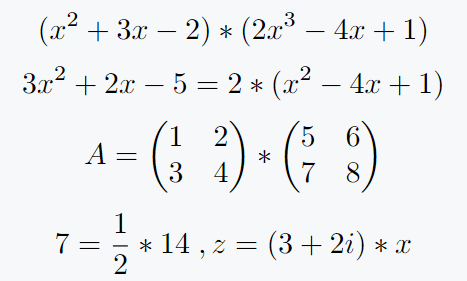
 \[ (x^2 + 3x - 2) * (2x^3 - 4x + 1) \]
 \[ 3x^2 + 2x - 5 = 2 * (x^2 - 4x + 1) \]
 \[ A = \begin{pmatrix} 1 & 2 \\ 3 & 4 \end{pmatrix} * \begin{pmatrix} 5 & 6 \\ 7 & 8 \end{pmatrix} \]
 \[ 7 = \frac{1}{2} * 14 \; , z = (3 + 2i) * x \]
 \[ 2\sin(x) = 2 * \sin(x) \]
\end{document}
Output :
Using the \cdot Command
Another method is to use \cdot command, which specifically denotes multiplication.
\documentclass{article}
\usepackage{xcolor}
\begin{document}
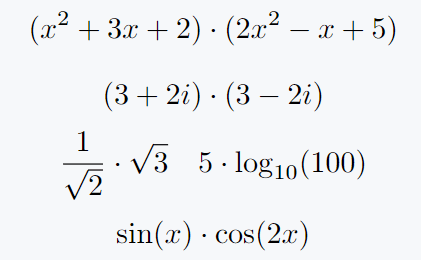
 \[(x^2 + 3x + 2) \cdot (2x^2 - x + 5)\]
 \[(3 + 2i) \cdot (3 - 2i)\]
 \[\frac{1}{\sqrt{2}} \cdot \sqrt{3}\quad  5 \cdot \log_{10}(100)\]
 \[\sin(x) \cdot \cos(2x)\]
\end{document}
Output :
Using the \times Command
The \times command is another option for representing multiplication in LaTeX. You can use it like a \times b to denote the multiplication of variables a and b.
\documentclass{article}
\usepackage{amsmath}
\begin{document}
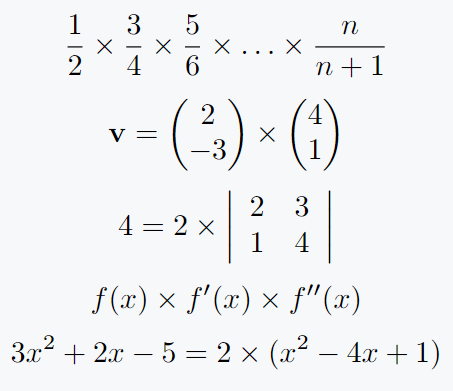
 \[\frac{1}{2} \times \frac{3}{4} \times \frac{5}{6} \times \ldots \times \frac{n}{n+1}\]
 \[\mathbf{v} = \begin{pmatrix} 2 \\ -3 \end{pmatrix} \times \begin{pmatrix} 4 \\ 1 \end{pmatrix}\]
 \[4 = 2 \times \left| \begin{array}{cc} 2 & 3 \\ 1 & 4 \end{array} \right|\]
 \[f(x) \times f'(x) \times f''(x)\]
 \[3x^2 + 2x - 5 = 2 \times (x^2 - 4x + 1)\]
\end{document}
Output :
Using parentheses for large expressions
In some cases, especially when dealing with complex expressions, you may want to use parentheses to clarify multiplication operation.
\documentclass{article}
\usepackage{amsmath}
\begin{document}
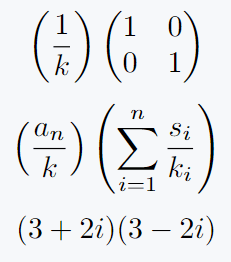
 \[\left(\frac{1}{k}\right)\begin{pmatrix} 1 & 0 \\ 0 & 1 \end{pmatrix}\]
 \[\left(\frac{a_n}{k}\right)\left(\sum_{i=1}^{n}\frac{s_i}{k_i}\right)\]
 \[(3 + 2i)(3 - 2i)\]
\end{document}
Output :


Jidan
LaTeX enthusiast and physics educator who enjoys explaining mathematical typesetting and scientific writing in a simple way. Writes tutorials to help students and beginners understand LaTeX more easily.