

Writing square roots in LaTeX is simple, but dealing with n-th roots requires a different method. Here, we’ll explain both approaches.
The simplest way to write roots in LaTeX is by using the \sqrt command.
\sqrt{expression}
When you need to write the nth root, though, a different syntax is required. This will be explained in detail in the next chapter.
Syntax of n-th Root
Friend, when you need to write the nth root, you have to use a slightly different format for the \sqrt command in LaTeX.
\sqrt[n]{x}
Here, we need \sqrt[n]{x} where n is the root you’re taking, and x is the number or expression whose root you’re calculating. For example,
\documentclass{article}
\begin{document}
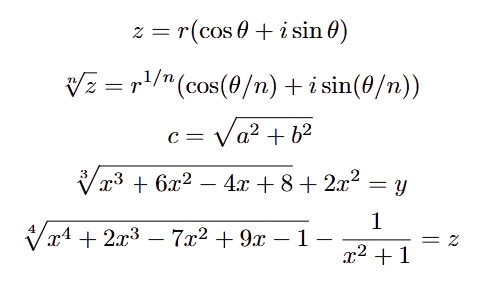
  \[ z = r(\cos \theta + i \sin \theta) \]
  \[ \sqrt[n]{z} = r^{1/n} (\cos(\theta/n) + i \sin(\theta/n)) \]
  \[ c = \sqrt{a^2 + b^2}  \]
  \[ \sqrt[3]{x^3 + 6x^2 - 4x + 8} + 2x^2 = y\]
  \[ \sqrt[4]{x^4 + 2x^3 - 7x^2 + 9x - 1} - \frac{1}{x^2 + 1} = z \]
\end{document}
Output :


Jidan
LaTeX enthusiast and physics educator who enjoys explaining mathematical typesetting and scientific writing in a simple way. Writes tutorials to help students and beginners understand LaTeX more easily.