

Latex diagonal dots are the sum of three dots located along the diagonal. This diagonal dots symbol is represented by the \ddots command.
These diagonal dots are used to represent a matrix with n number of elements.
\documentclass{article}
\begin{document}
   \[ \ddots \]
\end{document}
Output :

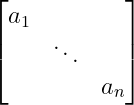
And you see the diagonal matrix where the elements of the matrix are arranged just along the diagonal. In that case, only the latex diagonal dots symbol is used.
\documentclass{article}
\usepackage{amsmath}
\begin{document}
 \[ \begin{bmatrix}
   a_{1} &  & \\
   & \ddots & \\
   &  & a_{n}
 \end{bmatrix}\]
\end{document}
Output :
Inverse diagonal dots
Inverse diagonal dots are located in a diagonal direction from southwest to northeast.
Latex has more than one command and method to represent this inverse diagonal dots symbol.
| Package | command |
| MySymbol | \udots |
| Mathdots | \iddots |
| yhmath | \adots |
| graphicx | \reflectbox{...} |
\documentclass{article}
\usepackage{graphicx}
\usepackage{yhmath}
\usepackage{mathdots}
\usepackage{MnSymbol}
\begin{document}
  \[ \iddots \]
  \[ \udots \]
  \[ \adots \]
  \[ \reflectbox{$\ddots$} \]
\end{document}
Output :

$\ddots$is passed as an argument in \reflectbox which converts diagonal dots symbol to inverse diagonal dots symbol. And for this, you need to take the help of graphicx package.


Jidan
LaTeX enthusiast and physics educator who enjoys explaining mathematical typesetting and scientific writing in a simple way. Writes tutorials to help students and beginners understand LaTeX more easily.