

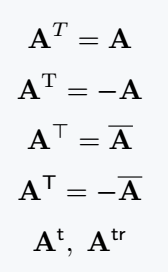
Transpose matrix is a mathematical symbol that different authors have identified in different ways in their books. E.g.
\documentclass{article}
\begin{document}
   \[ \mathbf{A}^T = \mathbf{A} \]
   \[ \mathbf{A}^\mathrm{T} = -\mathbf{A} \]
   \[ \mathbf{A}^\top = \overline{\mathbf{A}}\]
   \[ \mathbf{A}^\mathsf{T} = -\overline{\mathbf{A}} \]
   \[ \mathbf{A}^\mathsf{t},\; \mathbf{A}^\mathsf{tr}  \]
\end{document}
Output :
This \top command is in multiple packages. And the shape is different from the default command.
\documentclass{article}
\usepackage{MnSymbol}
\begin{document}
   \[ \left[\mathbf{A}^\top\right]_{ij} = \left[\mathbf{A}\right]_{ji}\]
   \[ \begin{bmatrix}
      11 & 12\\
      13 & 14\\
      15 & 16
   \end{bmatrix}^\top =
      \begin{bmatrix}
      11 & 13 & 15\\
      12 & 14 & 16
   \end{bmatrix} \]
\end{document}
Output :
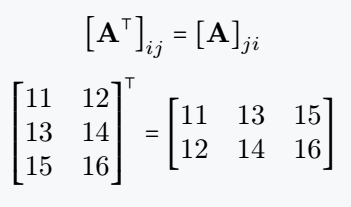
Use \intercal command for transpose matrix in LaTeX
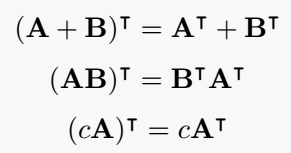
You see more than one method at the point above but amssymb’s \intercal command is the best practice to represent the capital letter T.
\documentclass{article}
\usepackage{amssymb}
\begin{document}
   \[ (\mathbf{A}+\mathbf{B})^\intercal = \mathbf{A}^\intercal + \mathbf{B}^\intercal \]
   \[ (\mathbf{AB})^\intercal = \mathbf{B}^\intercal\mathbf{A}^\intercal \]
   \[ (c\mathbf{A})^\intercal = c\mathbf{A}^\intercal \]
\end{document}
Output :
Power of transpose matrix
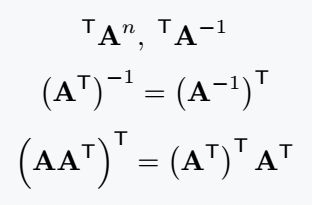
Symbols have been defined in different ways in different books to use power on transpose matrix.
In many cases, you will see that the superscripted T has been used before the matrix, and then the power has been used.
\documentclass{article}
\begin{document}
   \[ {^\mathsf{T}}\mathbf{A}^n,\;{^\mathsf{T}}\mathbf{A}^{-1}  \]
   \[ \left(\mathbf{A}^\mathsf{T}\right)^{-1} = \left(\mathbf{A}^{-1}\right)^\mathsf{T} \]
   \[ \left( \mathbf{AA}^\mathsf{T} \right)^\mathsf{T} = \left( \mathbf{A}^\mathsf{T}\right)^\mathsf{T}\mathbf{A}^\mathsf{T} \]
\end{document}
Output :


Jidan
LaTeX enthusiast and physics educator who enjoys explaining mathematical typesetting and scientific writing in a simple way. Writes tutorials to help students and beginners understand LaTeX more easily.